

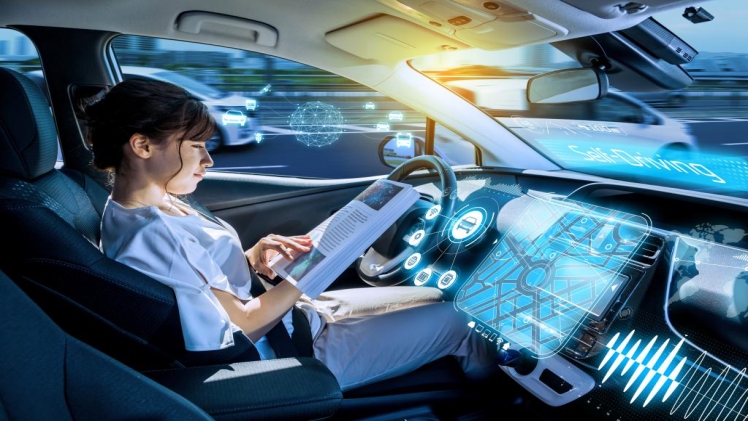
What is autonomous driving? Autonomous driving is a branch of automotive engineering which deals with a variety of machines that can drive on their own. An autonomous car, also called an autonomous vehicle, self-driving vehicle, or robotic vehicle, is a motor vehicle that is able to sense its surroundings and drive safely without any human input or direction. It can cruise at a speed of up to 55 miles per hour, can make decisions about its speed, breaks, and other driving practices, and can avoid accidents, depending on the laws of its state. A fully automated car would, of course, do these same things, except in a more manual way.
The first vehicles to fully implement autonomous driving technology were, of course, helicopters. In the 1960s, the United States Air Force began using helicopter gunships to scout for terrorists and remote-controlled aircraft to take out airfields. Helicopters could not move autonomously over desert areas or snow-covered ground, so they had to be constantly monitored by a human in the control room. From that point, however, different versions of the vehicle were developed which, while possessing the basic characteristics of the original helicopter, were designed to be much more flexible for all conditions.
As the popularity of these vehicles increased, they were made available to the general public. As autonomous vehicles became more popular, so did the applications for them. Today, autonomous vehicles are commonly used in many different kinds of transportation systems, including cars, trucks, buses, vans, and even motorcycles. There are even companies that sell and install the software necessary to drive some of these vehicles, on a widespread basis. Because of the wide variety of uses for these vehicles, the term “autonomous driving” has become widely accepted.
The most significant advancement to autonomous driving came about because of the development of fully automated, semi-autonomous cars. These cars still require the driver’s attention and approval before the car will drive off course. In the same way that fully automated cars can only park themselves, semi-autonomous cars can follow preset routes, remain within the lines of sight of their drivers, and even parallel park themselves. A semi-autonomous car can also make turns without the driver’s authorization or knowledge, and sometimes even change lanes without the driver’s approval. These features are only the beginning of the immense potential that this technology holds.
Because of the tremendous potential that these technologies hold, the generic term “autonomous driving” has been gaining in popularity. By adopting this term, people are no longer limited to using the term semi-autonomous when describing a vehicle. Now, any vehicle which is capable of operating on its own, either in autonomous mode or with the assistance of some kind of human defensive driving Texas feature, is considered to be a fully-automobile or fully-parallel autonomous driving system.
Semi-autonomous cars can be classified in a number of different ways, depending on how the vehicle drives. In general, fully-automobile cars are those which can perform all of the functions that are necessary for controlling the car: controlling acceleration, braking, turning, etc; as well as parking and going into turns on their own. Semi-autonomous cars use some form of external sensors to detect obstacles and the surrounding environment, as well as integrate their sensors with the computer code of the car so that the car can perform all of these tasks without the active
control of the driver. However, when the vehicle is operating in a fully-parallel mode, that is, without the direct involvement of the driver, it uses its own internal GPS sensors to navigate itself around potentially congested roads and highways.
When fully-parallel autonomous driving is achieved, the car no longer needs the active participation of the driver as it would in a fully-automobile scenario. This is achieved through mapping the roads ahead and determining the best route to take at each given point in time. The mapping information from the autonomous driving system is fed into the central controller of the vehicle which then uses this information to decide on the best way to get to its destination. In fact, in the future, it is very possible that an autonomous driving system could eliminate the need for a human driver altogether. Such a system would make complete use of available real-time data from the autonomous vehicle to make decisions about the safest and most efficient route to take and also minimise the risks of making errors in judgment. It is, for example, possible to drive semi autonomously through a city that has traffic congestion or in the busy cities using a mixture of data and real-time intelligence from the onboard computers and the GPS sensors installed in your car.
As exciting as it sounds, self-driving cars will never be totally autonomous. Semi-autonomous or fully-automated cars will need the active help of a human driver in some cases to take over certain tasks. However, with further development in technologies and computer science, such cars will be able to drive themselves on their own, i.e. without any help from the driver.
Many of the features upgraded to assist with autonomous driving are covered under extended auto warranty. If you are interested in purchasing extended car warranty for your car, it is a good idea to go online and research what types of coverage may be available.
The future of the automobile industry is changing and there is still so much more to learn.
