

As industry 4.0 continues to create more ways for industrial devices and machines to be connected, and thus improve upon productivity through automation and the Internet of Things (IoT), businesses in many forms have been able to grow at rates that were never before possible.
Behind this growth and paving the way for companies to become more successful, are the lessons and ideas that are born from the massive amounts of data analytics. Business intelligence thrives when it has an actionable and realistic plan to follow, and these are only built through the ever-increasing sophistication of data management and data sciences.
Big Data
It used to be the case that consumer feedback was the only data source that a business enterprise had to work with. There was no need for data scientists, as a vendor could very easily manage the workload that only a handful of disparate sources of information would provide. Data access was also a lot more straightforward, as the sources were easy to compile into a single database. The only question that would matter then would be how does an enterprise implement the lessons that the data is providing, on the assumption that they are indeed going to use it.
With the growth of both the World Wide Web and the abilities of businesses to ask for, and receive, more feedback—data sources have increased exponentially. It is easier now for the consumer to reach the business with queries, ideas, comments, and complaints. However, the data services do not end there. Industry 4.0 has meant there is plenty of new and different sources of data, at every level of the businesses—from stock inventories to output numbers—and at a much wider range of intervals. This massive amount of information coming into an enterprise is known as big data.
Reading the Big Data
The problem with having all of this business data is that there is too much to make any sense of it. Much of it is abstract or unstructured data, meaning that it is nonsensical on its own and requires other insights to compare and contrast against in order for it to become useable again. With so many disparate data sources, and no single point of access, the idea of data integration into the enterprise’s business plans is incomprehensible.
The only real need that an enterprise has for big data is to see where they can learn and grow. With so much information and not a lot of time to read it, the technical details that they need are lost in the sheer volume of data.
Data Virtuality
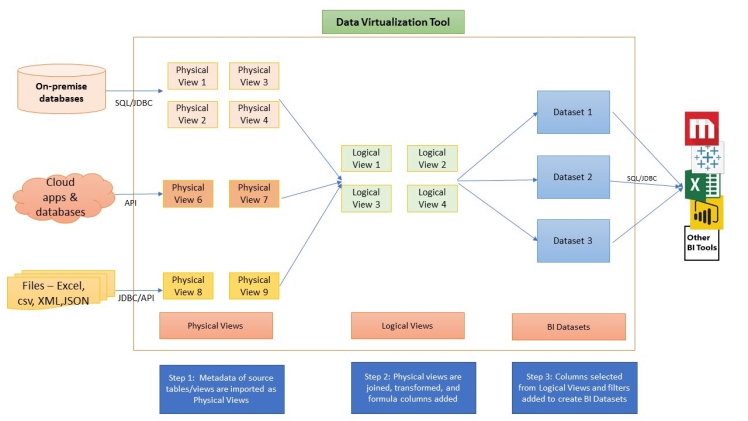
The solution is in data virtualization software. Data virtualization bridges the gap between all of the data sources, and actionable, useful (and readable) information. A form of data science, data virtualization software is employed by the business (or companies that are brought in to help the enterprise) and takes all of the big data, regardless of whether it is sorted, structured, unstructured, or abstract.
Then, data virtualization tools streamline all of the information into something a lot more useable. The data is gathered, combined, and filtered into one virtual layer (similar to a funnel with a stream of water) whereby it can then be analyzed and used appropriately. Businesses and enterprises can take the single platform of analytics and create a more useful business plan that is based on the information that data has given them.
Furthermore, having data virtualization tools is much faster, as they work to provide real-time access to the information and are much more cost-effective as it would take a team of people a huge amount of time to work through the compiled data.
Organizations of any size can use data virtualization in a bid to make sense of the growing amount of information that is headed their way. Data governance is one more sector that has grown from the fourth industrial revolution that is industry 4.0.
